



























A1 Batterypro | Generator Buying Guide
Choose the Right Generator for Your Power Needs
Choosing the right generator for a home power outage starts with three things: the appliances you want to run, their combined running watts, and any extra power they need when starting.
This generator size guide explains the essentials for Queensland households, with practical calculations, a Pramac inverter generator comparison and tips for Mackay and Townsville storm preparation.
Quick Answer: How Big Should My Generator Be?
There is no one-size-fits-all generator for a home. Add the running watts of the appliances you will use together, account for the largest likely start-up surge (or simultaneous surges), and choose a generator with adequate rated and short-term output. If you need to power fixed home wiring, speak with a licensed electrician.
01 / Start Here
How to Choose the Right Generator Size for Your Home
You may not need to power your entire house. Start with the things you would genuinely need during an outage, then calculate the demand they place on a generator.
List Your Essentials
Write down your fridge, freezer, lights, fan, router and other priorities. Decide what needs to operate simultaneously.
Add Running Watts
Find each appliance's actual running power on its rating label or in the manufacturer's specifications. Add the loads that run together.
Check Starting Surges
Consider motors starting, select appropriate spare capacity and check both rated and maximum generator output.
A1 Batterypro Tip
A planning margin of around 20–30% above normal running demand can be useful, but it does not replace checking motor starting surges, simultaneous starts or outlet limits.
02 / Know Your Appliances
What Can You Run During a Blackout?
These are approximate examples only. Real power consumption varies by appliance, operating conditions and model. Use the manufacturer's information to make your final choice.
Lower-Power Essentials
- LED light: approximately 5–15W each
- Internet router: approximately 10–30W
- Pedestal fan: approximately 40–100W
- Fridge while running: often 100–300W
A fridge or freezer may need substantially more power for a brief period when its compressor starts.
Loads Requiring More Planning
- Electric kettle: often 1,800–2,400W
- Microwave: check electrical input watts, not just cooking output
- Water pump or freezer: check the starting surge
- Air conditioner: check the exact system and start-up requirements
High-power heating appliances can use much of a small generator's available output on their own.
Can a Small Generator Run a Fridge, Freezer and Lights?
Possibly. Many fridges and freezers use relatively modest running power, but their compressors can demand much more during start-up. Check the starting requirement of both appliances, particularly if they may start together, before comparing a 2kVA or 3kVA generator. Lights and a router usually add less load than motor-driven equipment.
Generator Size Calculation: A Real-World Example
Imagine you want to run a fridge, three LED lights, a fan and your internet router during a power outage. Here is an illustrative calculation:
- Fridge: 180W running
- Three LED lights: 30W total
- Fan: 80W
- Internet router: 30W
Together, these appliances need 320W while running.
320W
Combined Running Demand
1,040W
Illustrative Demand While the Fridge Starts*
*How did we get 1,040W? We assumed the fridge needs 900W in total while starting, plus 140W for the other devices. This is only an example; your fridge may need a different amount. Additional appliances or motors starting together would change the result.
The right generator must handle normal running power and expected starting surges within its manufacturer's operating limits. Do not choose a generator based on the running-watts total alone.
Coming Soon: A1 Batterypro is working on a Generator Size Calculator for customers to use on our website. Once released, it will help you estimate your power requirements before comparing generators. You will still need to verify appliance specifications and starting loads.
04 / Understand the Label
Rated Watts, Maximum Watts and kVA Explained
The power a generator is designed to supply during normal operation, under the manufacturer's stated conditions. This is the key number for appliances running continuously.
Short-term power available under the manufacturer's conditions, often used when considering start-up demands. It is not a continuous operating rating.
Apparent electrical power. Its relationship with watts depends on power factor, so a generator's kVA name alone does not tell you how many continuous watts you can use.
For example, the Pramac P3000i is rated at 2,300W, with a 2,500W maximum. It cannot continuously provide 3,000W simply because its advertised size is 3kVA.
05 / Compare the Range
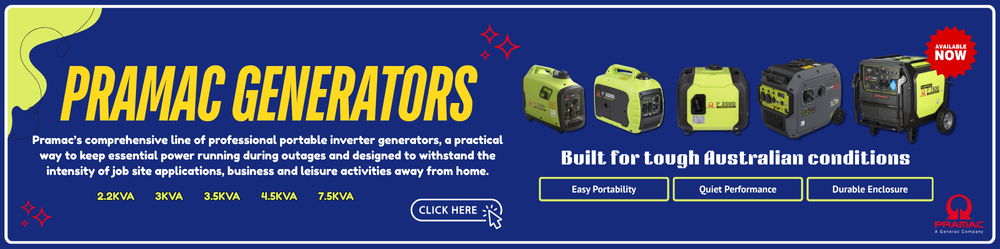
Pramac Inverter Generators: Compare Running Watts and Maximum Output
Wondering what a 2kVA, 3kVA or larger inverter generator can run? Start by comparing each Pramac model's rated watts and maximum watts below. Your appliance loads, starting surges and individual outlet ratings determine the final choice.
| Model | Rated Output | Maximum Output | Typical Consideration | More Information |
|---|---|---|---|---|
| P2200i | 1,900W | 2,100W | Selected essentials and smaller loads | View P2200i |
| P3000i | 2,300W | 2,500W | A modest appliance list with extra flexibility | View P3000i |
| P3500i | 3,000W | 3,300W | More running-power headroom | View P3500i |
| PMi4500i | 3,800W | 4,200W | A wider selection of essential loads | View PMi4500i |
| P7500i | 6,500W | 7,000W | Higher combined backup loads | View P7500i |
These are published model figures, which should be checked against the exact Australian unit supplied. Suggested applications are general guidance, not compatibility guarantees. Individual power outlet limits may be lower than the generator's total rating.
06 / Generator Technology
Inverter Generator vs Conventional Generator: What's Different?
An inverter generator uses electronic power conditioning to provide regulated output suited to many modern electronic devices. A conventional generator can also be useful for backup power, but suitability depends on its voltage regulation, power quality and the equipment being connected.
For either type, generator size matters just as much as power quality. A well-regulated generator that is too small for your fridge's starting surge still will not be the right choice. Check the requirements of sensitive appliances and always follow the generator and appliance manuals.
Queensland Backup Power
Preparing for Cyclone Season and Power Outages in Queensland
In Mackay and Townsville, choosing a portable generator before storm season gives you time to identify essential appliances, check safe outdoor operating locations and read the manual. Australia's official tropical cyclone season is from 1 November to 30 April, but blackouts can occur at any time.
A generator's power rating tells you what it can operate, but fuel tank capacity, electrical load and operating conditions help determine how long it can run.
Before severe weather, check your generator's maintenance schedule, fuel storage arrangements and the condition of your leads. Plan for how you will safely power essential items without overloading the generator. Never start or operate a petrol generator indoors or in unsafe weather conditions.
For quiet, lower-power backup needs, you might also consider a BLUETTI portable power station. Compare its output rating and usable stored energy before deciding.
07 / Safety First
How to Use a Portable Generator Safely
Petrol generators produce carbon monoxide and can cause fire or electric shock if used incorrectly. Follow the manufacturer's instructions and Queensland electrical safety guidance.
- Operate outdoors only: never inside a house, garage, carport or enclosed or partly enclosed area. Keep exhaust well away from windows, doors and air intakes.
- Keep the generator dry: do not operate it in rain, floodwater or dangerous storm conditions.
- Never backfeed a wall socket: connection to household wiring requires a licensed electrician and appropriate changeover or isolation equipment.
- Check leads and outlets: use suitable, correctly rated connections and follow the generator's individual outlet limits.
- Refuel safely: turn the generator off and let it cool before refuelling. Store petrol safely in approved containers.
Important Safety Information
Read the Queensland Electrical Safety Office's generator safety guidance before operating a portable generator.
08 / Common Questions
Generator Sizing Frequently Asked Questions
Will a 2kVA generator run a fridge?
Can a 3kVA generator power my entire home?
What's the benefit of an inverter generator?
Can I run an air conditioner from a portable generator?
What size generator do I need to run a fridge and freezer?
What can a 5kVA generator run during a blackout?
How long can a petrol generator run continuously?
Can I connect a generator to my home power points?
Generator outputs are published manufacturer figures and should be checked for the exact model supplied. Appliance wattages and worked examples in this guide are illustrative, not guarantees of compatibility. For generator safety, refer to the Queensland Electrical Safety Office.
